

Hey everyone,

If you’ve been working in the lighting game for even a little while, you’ve probably run into DMX splitters. They’re the unsung heroes of any show—whether it’s a small club night, a theater production, or a big festival—keeping your DMX512 signal strong and split evenly to all your lights. But here’s the question that pops up all the time in our DMs, at trade shows, and over coffee with other lighting techs: does a DMX splitter even need power? I get it, when you’re scrambling to set up gear right before a gig, the last thing you want is to have to hunt for a power outlet when all you thought you had to do was plug in cables. Let’s break this down, no tech jargon overload, and throw in some real-world examples from our side as a DMX splitter supplier who’s dealt with this exact headache more times than I can count.
First off, let’s keep the basics straight for anyone new: DMX512 is the standard signal that runs most stage, club, and architectural lighting. It’s a serial signal that controls dimmers, moving heads, LED pars, all that good stuff. A splitter takes one incoming DMX signal and splits it into multiple outputs—usually 2, 4, 8 channels, whatever you need—so you can run lights in different zones without signal degradation. Now, the power part. Not all splitters are the same, and that’s the biggest mistake people make: assuming every splitter works the same way.
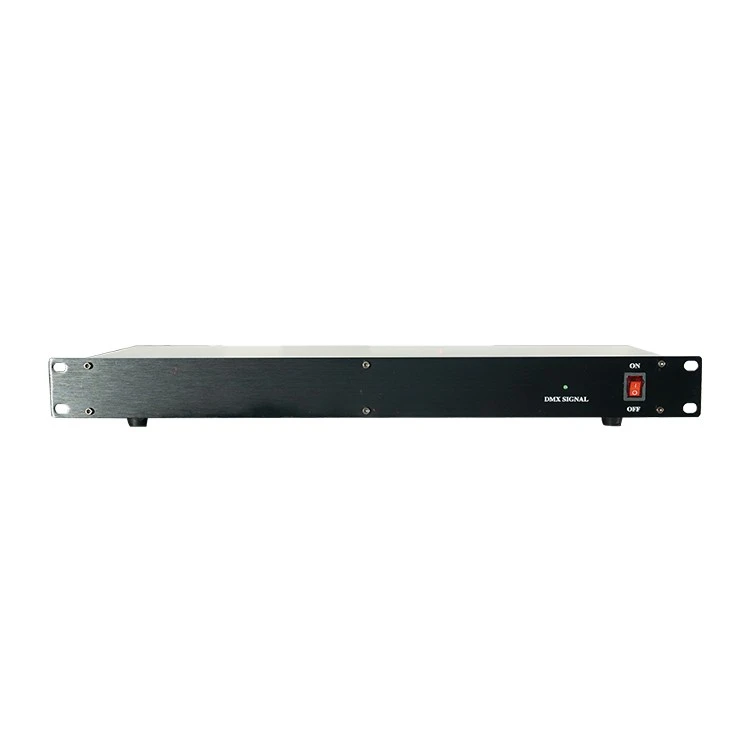
Let’s start with passive DMX splitters, because that’s where a lot of the confusion comes from. Passive splitters are, technically, cable splitters—like the ones you use to split a cable TV signal. They don’t have any extra components, no chips, no power source. All they do is physically split the DMX cable so the signal gets sent to multiple outputs. But here’s the catch: DMX512 signals are low-voltage, and if you split a passive splitter beyond a couple of outputs, or run long cable runs, the signal gets weak, garbled, or drops entirely. I’ve seen guys try to run a 8-way passive splitter for a small theater show, and by the end of the second act, half the moving heads were flickering like a old CRT TV. Passive splitters only work for super short runs, tiny setups, and very few outputs—like 2 max, maybe 3 if you push it. But for anything more serious? Passive is a no-go, and that means you need an active splitter—you guessed it, the ones that need power.
Active DMX splitters are the workhorses, and they’re the ones we sell most of here. What makes them active is that they have built-in amplifiers that boost the DMX signal before sending it to each output. That’s why you can run 8 outputs, each with a 1,000-foot cable run, and the signal stays crisp. But those amplifiers need power. There’s no way around it. The amplifier can’t do its job without juice, so if you plug an active splitter into a DMX cable only, it’ll do absolutely nothing—no signal split, no boost, dead device. I’ve had a customer call me panicking at 2 PM the day of a wedding reception, saying his splitter “stopped working” 20 minutes into setup. Turns out he grabbed an active splitter from his rental kit, thought he just needed to plug in the DMX in and out cables, and didn’t see the tiny DC power port on the side. By the time we talked him through grabbing a portable power brick to plug into it, he only missed a couple of test runs—phew. That’s the exact kind of mistake we help people avoid every week.
Now, let’s dive into the types of power active splitters use, because that’s another common point of confusion. Most of our splitters work with either DC power (like a standard power adapter) or phantom power over DMX, and some even have options for both. Wait, phantom power? Is that the same as the phantom power for mics? Kinda, but not exactly for DMX. Phantom DMX power is when the splitter pulls a tiny bit of power from the incoming DMX signal cable, usually pins 1 and 3 (since they’re grounded, no signal on them), so you don’t need a separate power adapter. But here’s the fine print: phantom power only works for short cable runs, and only for lower-output splitters. If you’re running an 8-channel splitter with long cables, phantom power might not be enough to run the amplifiers, and you’ll end up with dead outputs. That’s where a dedicated DC power source comes in.
Take our 8CH DMX512 Splitter Controller for example—you can check it out here: /lighting-accessory-equipment/dmx-splitter/8ch-dmx512-splitter-controller.html. This bad boy is an active splitter, and it needs either a DC power adapter or phantom DMX power if you’re on a tight setup. We recommend using the dedicated power adapter for any run over 500 feet, because the amplifiers for 8 outputs draw a little more juice, and phantom power can’t keep up. I’ve used this exact model at a 3-day music festival last year, where we had to run cables across a field to a main stage and two side stages. Plugging each splitter into a power outlet was easy, and we never had a single signal dropout—even with 200+ lights on the same circuit.
Then there’s our Outdoor 4CH DMX512 Splitter Controller, linked here: /lighting-accessory-equipment/dmx-splitter/outdoor-4ch-dmx512-splitter-controller.html. Outdoor gear needs to be tough, and that includes power. This splitter is IP65-rated, so it can handle rain, dust, and all the elements you throw at it, but it still needs power. We designed it to work with both a standard AC power adapter (for permanent outdoor installations, like architectural lighting on a building facade) and a 12V battery (for temporary setups like outdoor concerts or holiday light displays). A lot of people ask if we make a passive outdoor splitter for short runs, but passive ones just can’t hold up to the long cable runs and weather interference outdoors. You need that power to keep the signal strong, and this splitter’s rugged design makes it perfect for that.
Wait a second, is there any scenario where you don’t need power for a splitter? Let’s be 100% clear here: if you’re using a passive splitter, it doesn’t need external power. But it also only works for tiny, simple setups. I’m talking like 2 outputs max, cables under 100 feet, no multiple lights pulling heavy signal. If you’re running even a small club night with 10 LED pars, that’s 10 outputs, and a passive splitter will cut the signal so much that some pars won’t turn on at all. That’s why for any professional or semi-pro setup, an active splitter is non-negotiable—and active means power is non-negotiable.
Another thing people mix up: the difference between powering the splitter and powering the lights. The DMX splitter only handles the signal, not the power for the lights themselves. Your LED pars or moving heads get their power from their own outlets, or from power over Ethernet if they’re smart lights. The splitter’s power is only for its amplifiers to boost the DMX signal. That’s a common misconception—we get emails all the time asking if the splitter can power their lights, and we have to gently explain that no, it’s just for the signal.
Let’s talk about what happens if you plug an active splitter without power. I’ve tested this more times than I care to admit (shoutout to my old test bench where half the components are busted from bad setups). If you plug an active splitter into a DMX cable only, here’s what happens: nothing. No signal goes through, no outputs work, the splitter doesn’t light up, nothing. Some cheaper no-name splitters might have a tiny LED that flickers, but the signal is still garbage. Active splitters rely on that power to amplify the signal, so without it, they’re just a fancy cable connector that does nothing. Passive splitters, on the other hand, will pass the signal, but again, only for tiny setups.
Now, let’s get into some tips from our team here, since we work with DMX splitters every single day. First: always check what kind of splitter you have before you set up. If it has a power port (usually a round DC jack or a plug for an AC adapter), it’s active and needs power. If it’s just a bunch of DMX cable ports and no power port, it’s passive and only for small runs. Second: when choosing power for your active splitter, match it to your setup. If you’re indoors, a standard power adapter is fine. If you’re outdoors or need portability, go for a DC battery option. If you’re in a pinch, check if your DMX controller supports phantom power—some do, so you don’t need a separate power adapter. Third: always test your setup before the show. I learned this the hard way when I set up a small birthday party for a friend, grabbed what I thought was a passive splitter, and spent 20 minutes troubleshooting why the lights weren’t working, only to realize it was an active one with no power. Don’t be that person.
Let’s also clear up a myth: some people think that if you run the DMX signal through a powered controller, you don’t need a powered splitter. That’s half true. A powered controller can boost the signal, but if you’re splitting it to multiple outputs, each output still benefits from its own amplifier. Even a strong controller can only push so much signal to so many outputs. Adding a powered splitter at the distribution point will make sure every output gets a clean, strong signal, no matter how many lights you have. We had a customer last year who tried using just a powered controller for a corporate event with 50 lights, and by the time they got to the 30th light, the signal was so garbled that the colors were wrong and some lights wouldn’t move. Adding a powered splitter fixed it instantly—case closed.
If you’re still on the fence about whether your setup needs a powered splitter, here’s a quick checklist: 1) Do you have more than 4 lights on a single DMX line? 2) Are your cable runs longer than 100 feet? 3) Do you have lights in multiple zones that need separate control? If you answered yes to any of these, you need an active splitter, and that means you need power. No exceptions.
Now, if you’re in the market for a reliable DMX splitter that fits your exact setup, we’ve got you covered. Whether you need a small 8-channel for club nights, a rugged outdoor one for holiday displays, or something in between, our team can help you pick the right one. We’ve been working with lighting techs, event companies, and even home hobbyists for years, so we know exactly what works for different setups. If you have questions about power requirements, splitter types, or even setup tips, don’t hesitate to reach out and connect with our team to discuss your needs.
At the end of the day, the whole point of a DMX splitter is to keep your show running smoothly, and power is a non-negotiable part of that for any serious setup. Passive splitters might work for tiny jobs, but active splitters with power are where it’s at for anything that matters. Don’t make the mistake of grabbing a splitter without checking if it needs power—you’ll thank yourself when your next gig runs without a single glitch.
Catch you all next time with more lighting tech hacks,
[Your Name]
References:
- DMX512 Lighting Control Standards. USITT (United States Institute for Theatre Technology), 2022.
- DMX Signal Amplification and Splitting Best Practices. Lighting Design & Specifier Magazine, 2023.
- Industrial and Outdoor DMX Equipment Ratings. National Electrical Manufacturers Association (NEMA), 2021.